ASUS · اللوحات الأم
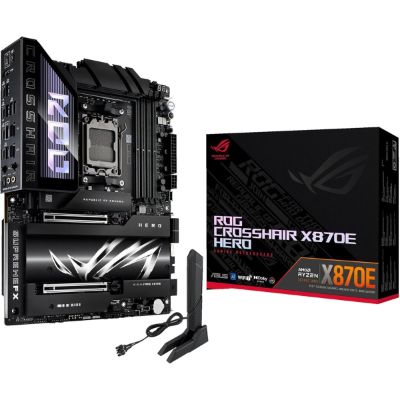
ASUS ROG CROSSHAIR X870E HERO AMD AM5 Motherboard DDR5 192GB EXPO Wi-Fi 7ROG Crosshair X870E Hero
من 599 د.أمتوفر
مقارنة عبر 5 متاجر

ROG Crosshair X670E Hero
AMD Socket AM5(LGA 1718) for AMD Ryzen 7000 Series Desktop Processors · Intelligent Control: ASUS-exclusive tools including AI Cooling II and Two-Way AI Noise Cancelation for easy configuration · Robust Power Solution: 18 plus 2 teamed power stages rated for 110A, ProCool II power connectors, MicroFine alloy chokes…
| المتجر | السعر | التوفر | الإجراءات |
|---|---|---|---|
 City Center | 499 د.أ | غير متوفر | زيارة المتجر |
متجر واحد فقط في هذا الكتالوج يعرض هذا المنتج. تأكد من السعر النهائي لدى المتجر.
أضيف أقل عرض 2024-01-09 · حُدث 2026-11-23 · لم يُسجَّل أي تغيير للسعر
ابحث عن عروض المتاجر الأخرى| Product Specifications | |
|---|---|
| Manufacturers Link | https://rog.asus.com/motherboards/rog-crosshair/rog-crosshair-x670e-hero-model/spec/ |
| Motherboard Specifications | |
| CPU Support | AMD Ryzen VII Generation |
| CPU Socket Type | AM5 |
| Chipset | AMD X670 |
| Form Factor | ATX |
| Memory Type | DDR5 |
| Memory Speed | 6400 Mhz |
| Maximum Memory | 128 GB |
| Memory Slots | 4 Slots |
| M.2 Slots | Yes |
| Wireless LAN | Yes |
| Warranty | |
| Warranty | 1 Year |
The lowest price from 30 days before the promotion:
Unyielding power delivery and robust thermal management form the indelible tenets of its creed. Hyperspeed connectivity, comprehensive PCIE 5.0 and DDR5 support, and Polymo lighting add potent layers of build personalization on top. And the finishing touches are added by exclusive utilities and overclocking controls that allow you to uniquely flex the performance of Ryzen 7000 Series processors. Define your AM5 build with the ROG Crosshair X670E Hero. This platform delivers the power and connectivity that advanced AI PC applications demand.
Click to check out our X670 Motherboard Guide
・ 2 x PCIe 5.0 x16 Safeslots (x16, x8/x8)
Topmost PCIe 5.0 slot also has an M.2 backplate
・ ESS® ES9218 QUAD DAC high-definition DAC
USB Type-C® front panel connector supports QC4+
Providing greater electrostatic protection than the industry standard. ESD Guards cover the USB, audio and LAN ports.
USB power supplies a rock-steady 5 volts to all USB ports, minimizing power fluctuations for minimal data loss.
The innovative Q-Latch makes it easy to install or remove an M.2 SSD without the need for specific tools. The design employs a simple locking mechanism to secure the drive and neatly eliminate traditional screws.
Reinforced to protect the motherboard and PCIe expansion cards from damage.
LED panel that shows 2-digit codes to indicate power status and potential problems for quick diagnosis.
One-sided clips for super simple and secure handling of memory modules.
At its default, FlexKey functions as a system reset button, but it can also be easily reassigned to quickly turn Aura lighting on or off, activate Safe Boot, or enter the BIOS.
A physical button unlocks the first PCIe slot’s security latch with one tap, greatly simplifying the process of detaching a PCIe card from the motherboard when it’s time to upgrade to a new GPU or other compatible device.
Simple adapter that helps arrange front-panel cables in an orderly manner.
The grueling demands of the mightiest AMD Ryzen™ 7000 Series processors are no match for the eighteen 110A-stage power solution of the ROG Crosshair X670E Hero. Its massive headroom opens up incredible overclocking potential, bolstered by a combo attack of unique ROG technologies and champion-level DDR5 speeds.
Take Ryzen beyond the already impressive sum of its parts. Dynamic OC Switcher and Core Flex create additional frequency waypoints for single and multi-threaded workloads, allowing Ryzen to break boundaries and achieve peak performance in all games and apps.
Tuning is now faster and smarter than ever before. ASUS AI Overclocking profiles the CPU and cooling to predict the optimal configuration and push the system to its limits. Predicted values can be engaged automatically or used as a launching ground for further experimentation.
As the first foray of AI Overclocking on an AMD architecture, the set of parameters has changed substantially, but voltage and clock speeds are still the primary targets for adjustment. Every core has a recommended VID and frequency, with the latter based on a combination of ratio and Asynchronous BCLK tuning.
Predictive settings in the utility are designed to work in tandem with Precision Boost Overdrive (PBO), but they go one step further by enhancing the values for EDC, TDC, and PPT, as well as tuning the curve optimizer.
Finally, by enabling the Dynamic OC Switcher, AI Overclocking ensures that the CPU is using ideal settings whether in single- or multi-threaded workloads.
Lightly-threaded tasks get fantastic uplift using AMD Precision Boost Overdrive (PBO), but all-core frequencies can be pushed higher via traditional overclocking. The Dynamic OC Switcher lets you use them both, dynamically engaging PBO or your preferred settings based on the CPU current or temperature.
The best way to overclock Ryzen 7000 with ROG's Dynamic OC Switcher.
Example: If a user sets thresholds for current and temperature as shown, once CPU current exceeds 35A, the manual overclock engages until the temperature reaches 80°. At all other times, Precision Boost Overdrive will be used.
The Dynamic OC Switcher lets users automatically switch between manual OC and PBO.
Core Flex empowers you to smash limits farther than ever before by letting you control clock, power, and thermals in creative new ways. In its simplest form, you can maximize base clock during lighter loads and set breakpoints to gradually reduce CPU core frequency as temperature or current increases. But the system is extremely adaptable, supporting multiple user-controlled functions that can manipulate power, current, and temperature limits independently so that you can bend CPU performance to your will.
Core Flex lets you fine-tune overclocks.
For this CPU, the base clock (BCLK) can be stably increased to give an extra boost during lightly threaded workloads. At Level 1, the BCLK is set to 104, and it remains at that frequency until the current reaches 35A. Then the BCLK drops down to 102, and stays in that Level 2 range up until 55A. From that point on, the CPU is using most or all of its threads, so the BCLK scales back to the default 100.
By managing the Electrical Design Current (EDC) in tandem with the total current, this CPU can gain extra performance for short, demanding bursts. During lightly threaded workloads, below 35A, the Level 1 EDC is set to a low value, in this case 60. As more cores are needed, the EDC is set to 120, which was found by this user to be a sweet spot for performance. Once the CPU passes 70A, it is in multi-threaded territory, where it was found that a high EDC of 250 gave optimal performance.
In order to let the CPU cool off if its temperatures go too high, this user constrains the Package Power Target (PPT) when thermals increase. Specifically the short-term value (“Fast”) is used. Until the CPU reaches 70°, it can run at full performance, so 350W is set to give plenty of overhead. At that point, the power limit reduces to 220W, to let the CPU start reducing heat. If it is still under sustained load and keeps getting hotter, then a more stringent 165W PPT is set at 85°.
For next-level frequency flexibility, the ROG Crosshair X670E Hero features a built-in clock generator that isolates CPU base clock from memory, PCIe, and the Infinity Fabric speed. Drive CPU performance to its absolute brink while maintaining the stability of related clock domains.
Separate CPU BCLK from other components for a stable overclocking edge
Separate CPU BCLK from other domains for unfettered overclocking
AMD Precision Boost Overdrive (PBO) pushes the CPU current and voltage budget to opportunistically increase performance. By aggressively tuning the PBO parameters, AMD’s algorithm can leverage the motherboard’s robust power solution to ramp up performance even higher.
Click to learn more about PBO Enhancement
Today's CPU architectures place incredible demands on motherboard power design by transitioning from deep power-saving modes, going from lower-power mode to full load in an instant. The latest ROG VRM architecture rises to the challenge by utilizing teamed power stages to rapidly swing current, while maintaining exemplary thermal performance.
ASUS became the first manufacturer to implement phase-doublers with the A8N32-SLI Deluxe motherboard, back in 2005. The board's VRM was lauded for elegantly overcoming the power handling capabilities of components that were available at the time while also reducing voltage ripple. Those benefits led to phase-doublers becoming universally accepted in the industry, and they are still used for similar purposes today.
Modern CPUs pack more cores than their predecessors, and the latest instruction sets allow them to crunch computationally dense workloads at an incredible pace. In addition, they consume less power at idle and can transition between load states much more quickly. These improvements necessitate a re-evaluation of power-design priorities because phase-doublers add a propagation delay that hampers transient response.
Fortunately, the latest integrated power components can handle higher currents than the devices of yesteryear, making it possible to implement a simple circuit topology that isn't hamstrung by the processing lag of phase-doublers. That's why the ROG Crosshair X670E Hero utilizes teamed power stages to deliver higher burst current per phase, while maintaining the thermal performance of phase-doubled designs.
Each VRM component serves a specific purpose. PWM controllers and phase-doublers control the circuit, and the power stages do the heavy lifting from an electrical and thermal standpoint. The power stages feature low RDSON to reduce switching and conduction losses, helping to improve overall thermal headroom.
Two ProCool connectors ensure a snug and reliable connection to the EPS 12V power lines.
The VRM features 18+2+2 power stages, each rated to handle up to 110 amps.
Each power stage is accompanied by a high-permeability alloy-core choke rated to handle 45 amps.
Input and output filtering is provided by solid-polymer capacitors rated for high operating temperatures.
Comprehensive memory tuning options are the cornerstone of ROG motherboards. With the ROG Crosshair X670E Hero, you can extract all of the potential out of your DDR5 modules, regardless of if they're from an extreme-speed kit or an entry-level set that would otherwise be locked.
For those who want to fly past stock DDR5 speeds, the ROG Crosshair X670E Hero is primed and ready for enthusiast-grade kits courtesy of vast AMD EXtended Profiles for Overclocking (EXPO) support. Seasoned veterans can further tweak performance via the extensive array of settings in the UEFI.
DIMM Fit is an ASUS-exclusive BIOS feature that precisely analyzes individual memory modules to optimize performance and pinpoint potential issues. DIMM Fit Pro gives advanced PC builders more extensive customizability for memory tuning. It allows users to control up to twenty overclocking parameters, define testing ranges, and prioritize stability or performance, offering a more flexible and granular approach to memory optimization.
ASUS Enhanced Memory Profile (AEMP) is an exclusive firmware feature for PMIC-restricted memory modules. AEMP automatically detects the memory chips on your kit and then presents optimized frequency, timing and voltage profiles that you can effortlessly apply to unleash performance.
Every layer of the Hero's armor is painstakingly forged to keep it cool under stress. Enormous heatsinks have been strategically hewn to offer massive thermal headroom to the VRM, while both chipsets share a large central plate for widespread dissipation. Filling in the gaps, the M.2 slots have vast heat spreaders to let installed drives plow through intense PCIe 5.0 transfers without breaking a sweat.
A VRM heatsink on the MOSFETs and chokes is connected to the aluminum I/O cover via an embedded heatpipe to increase mass and surface area for dissipation.
Three dedicated heatsinks keep up to four M.2 drives in the optimum operating temperature range for consistent performance and reliability.
A high-quality thermal pad is utilized between the power stages and heatsink, helping to improve heat transfer and reduce VRM operating temperatures. For future maintenance, a spare thermal pad is included in the product box.
The topmost M.2 slot features a backplate block to ensure that an installed high-performance drive delivers peak performance, even when airflow is restricted.
A dedicated heatsink draws heat away from both chipsets to maintain optimum operating temperature.
An extensive array of headers line the ROG Crosshair X670E Hero for precise cooling control and monitoring:
Each header can be set to monitor and react to three user-configurable thermal sensors for workload-based cooling, and all settings can be easily managed by Fan Xpert 4 or UEFI.
Every onboard header supports auto-detection of DC or PWM fans.
A dedicated PWM/DC header for self-contained water-cooling setups.
Dual water-temperature headers and a flow-rate header feed information straight into Armoury Crate, allowing you to track coolant temperatures and the flow rate of the entire loop.
A dedicated header can supply over 3 amps to a high-performance PWM or DC water pumps.
A dedicated header enables monitoring of temperatures at the input/output points of any component.
A dedicated header enables constant monitoring of flow rate throughout the entire loop.
The ROG Crosshair X670E Hero bears the same mounting hole alignment as AM4 platforms, so it is backward compatible with many existing coolers, including all AIO offerings from ASUS and ROG.
The dual-chipset design of the ROG Crosshair X670E Hero brings a wealth of bandwidth for connected devices so that you can have it all. WiFi 6E, 2.5G LAN, and dual USB4 ports all grace the rear I/O, flanked by plenty of additional ports for all your devices. On-board SupremeFX audio delivers premium, immersive sound, now using an improved ESS quad-DAC amplifier. And under the hood, up to five PCIe M.2 drives can be loaded up for blazing fast load times and transfer speeds.
Fully embracing the new standard, the ROG Crosshair X670E Hero offers abundant Gen 5 support to give unfettered bandwidth to the fastest SSDs and graphics cards available.
The ROG Crosshair X670E Hero features four onboard M.2 slots, two of which are PCIe 5.0-ready to offer blistering 16 GB/s speeds, while the accompanying pair can deliver still-impressive 8 GB/s transfers through their PCIe 4.0 interfaces.
For even more storage, the bundled PCIe 5.0 M.2 Card features an additional Gen 5-ready slot, and boasts ample surface area for dissipating the heat of a full-size 22110 drive.
Both of the x16 expansion slots have the PCIe 5.0 treatment to offer incredible speeds up to 64 GB/s for compatible devices. To bear the brunt of massive graphics cards, they are also protected with SafeSlot retention brackets, and the top slot can be released easily thanks to the Q-Release button.
USB 3.2 Gen 2x2 adds an additional lane that can boost Type-C data transfers with speeds of up to 20 Gbps. The port also features Quick Charge 4+ technology that can quickly charge devices up to 60W*.
Each USB4® port delivers up to 40 Gbps of bidirectional bandwidth for the latest super-speed devices and drives. External display support reaches up to 8K output if one of the ports is in use, or both can be employed for dual 4K displays.
Onboard WiFi 6E technology takes advantage of newly available spectrum in the 6 GHz band to provide up to seven 160 MHz channels for ultrafast throughput and better performance in dense wireless environments.
Onboard Intel® 2.5 Gbps Ethernet gives your wired connection a boost, with speeds that are 2.5 times faster than standard Ethernet connections for speedy file transfers, lag-free gaming, and high-resolution video streaming.
The antenna has two built-in transmitters and receivers to enable faster transmission speeds, and it supports the 2.4, 5 and 6 GHz bands.
Four-way positioning enables better signal reception.
A powerful magnetic base secures the antenna on the top or side of the PC case.
ROG SupremeFX audio technology delivers an exceptional 113 dB signal-to-noise ratio on the line-in connection to provide exceptional recording quality. There’s also a low-dropout regulator for cleaner power delivery to the SupremeFX ALC4082 codec, and an integrated ESS® ES9218 quad DAC capable of reaching -115dB THD+N for superior front-panel output. The combined solution allows for end-to-end 32-bit 384 kHz resolution playback that conveys all the subtlety and nuances of each audio track. ››› Learn more about ROG audio technology
Blocks electromagnetic interference from the motherboard or add-ons to provide cleaner audio.
The ESS® ES9218 integrated quad DAC amplifier is capable of providing -114 dB total harmonic distortion (THD+N) for standard audio devices, and can ramp up to 2Vrms on supported audiophile hardware. In addition, the 121 dB dynamic range (DNR) provides an extremely low noise-floor, further accentuating dynamics and punch.
Instead of the conventional high definition audio (HDA) interface, the ALC4082 codec uses a USB interface to deliver studio-level sound reaching up to 32-bit 384 kHz audio resolution.
Unique design allows the codec's impedance-sensing function to be ported with either the front or rear headphone outputs.
Fine-quality components that produce a warmer, natural sound with exceptional clarity and fidelity.
The ROG Crosshair X670E Hero provides a myriad of intuitive and flexible tools to optimize every aspect of your system.
The AI Suite 3 dashboard contains a set of intuitive controls that boost CPU performance while maintaining system stability.
The TurboV Processing Unit (TPU) is an intelligent onboard micro-controller that provides an array of system-tuning features, including the ability to fine-tune voltages, monitor system stats and adjust overclocking parameters.
The Digi+ voltage-regulator module (VRM) delivers real-time control over voltage droop, switching frequency and power-efficiency settings, allowing you to fine-tune CPU voltage regulation for ultimate stability and performance.
Modern processors feature per-core tuning, and the ASUS Turbo app makes use of this feature by letting you assign applications to specific processor cores, prioritizing computing power where it's needed most.
The renowned ROG UEFI (BIOS) provides everything you need to configure, tweak, and tune your rig. It offers intelligently simplified options for newcomers to PC DIY, as well as more comprehensive features for seasoned veterans.
When you’re ready for a deeper dive, delve into the UEFI’s Advanced mode and take complete control. Advanced mode enables full control over every aspect of the motherboard, and a built-in search function helps you quickly find the setting you need.
Quickly locate tuning options and add preferred tools to your favorites list.
Flash the latest BIOS via the internet from within the BIOS.
Check your storage device Self-Monitoring, Analysis, and Reporting Technology (S.M.A.R.T.) logs to gauge reliability or to identify potential failures.
Automatically detect selected ASUS graphics cards to view detailed information.
Restore your SSDs and NVMe storage to factory settings.
Track the last change and save preferred profiles to a USB drive.
Rename SATA ports for easy identification.
Port configuration settings between different BIOS versions or share them with friends.
Configure the fan's operating speed manually or use pre-configured Standard, Silent, Turbo, or Full Speed modes. By default, system fans will automatically switch to full speed if the temperature reaches 75° C.
Easily enable or disable Aura RGB lighting or every onboard LED, for a more subdued aesthetic.
Designed to simplify setup, EZ mode presents vital settings and stats on a single page. With guided wizards, drag-and-drop functionality, and one-click application of important settings, your rig will be up and running in no time.
Fine-tune individual fans simply by dragging a curve with the mouse.
View SATA port details for easy device recognition.
Use the mouse to quickly change time and date settings.
Conventional motherboards use single-ended sensing tapped from a location that isn't ideal, leading to a large disparity between the actual voltage fed to the CPU and the value reported to software. The ROG Crosshair X670E Hero features a differential-sensing circuit and delicate IC that simplify overclocking and tuning by allowing you to track voltages more accurately.
Balance the thermals and acoustics of any build with a single click. A proprietary ASUS algorithm slashes unnecessary noise while running a quick stress test, and then monitors CPU temperatures to dynamically adjust fans to optimal speeds.
This utility leverages a massive deep-learning database to reduce over 5 million types of background noise from incoming or outgoing audio, helping ensure crystal-clear communication in games or calls.




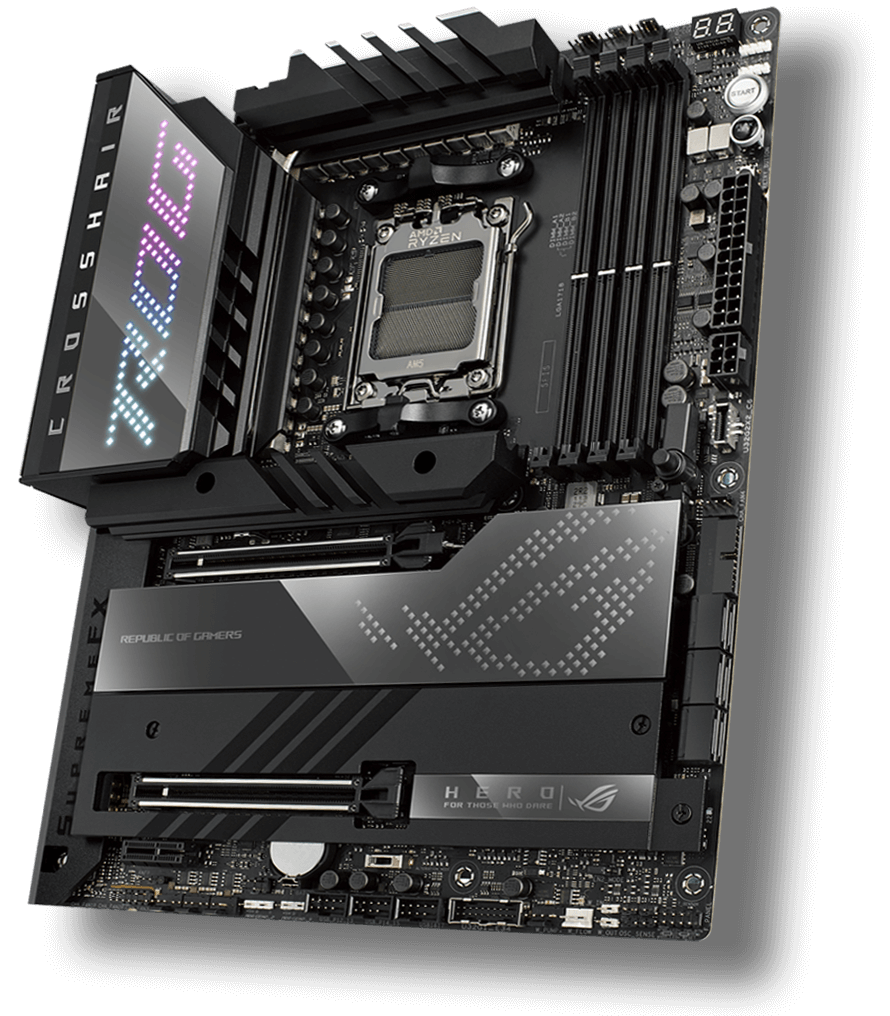











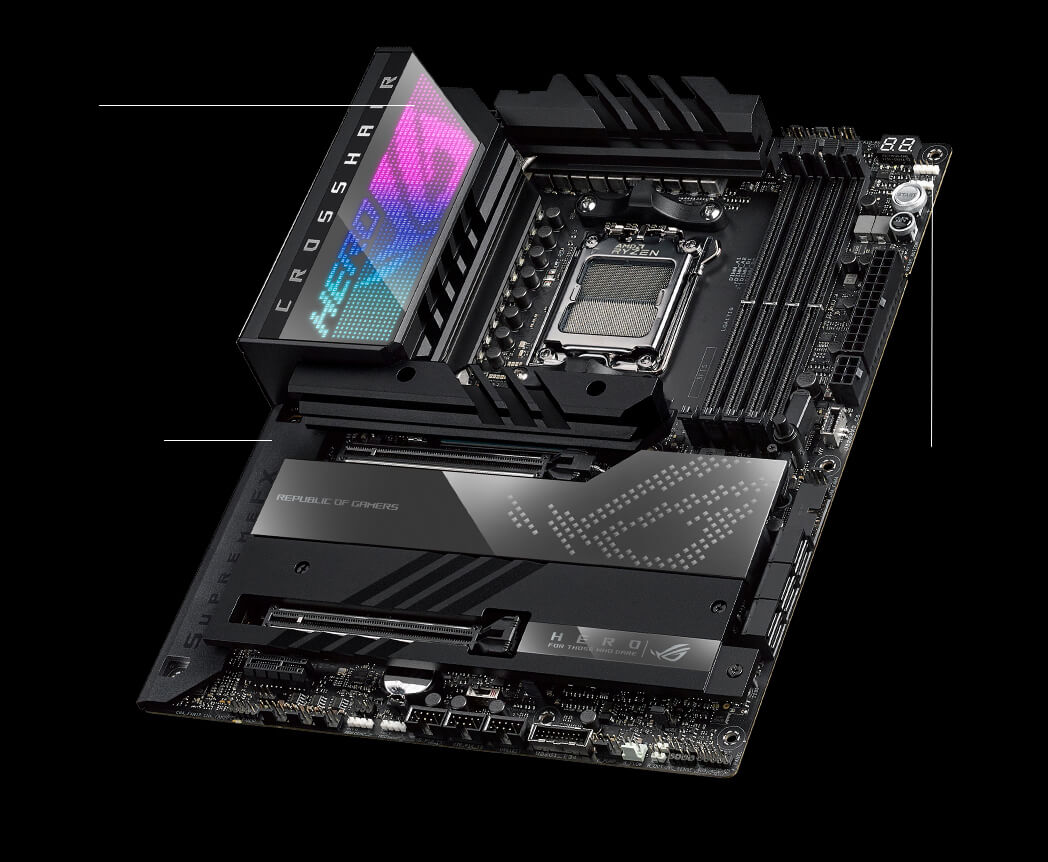
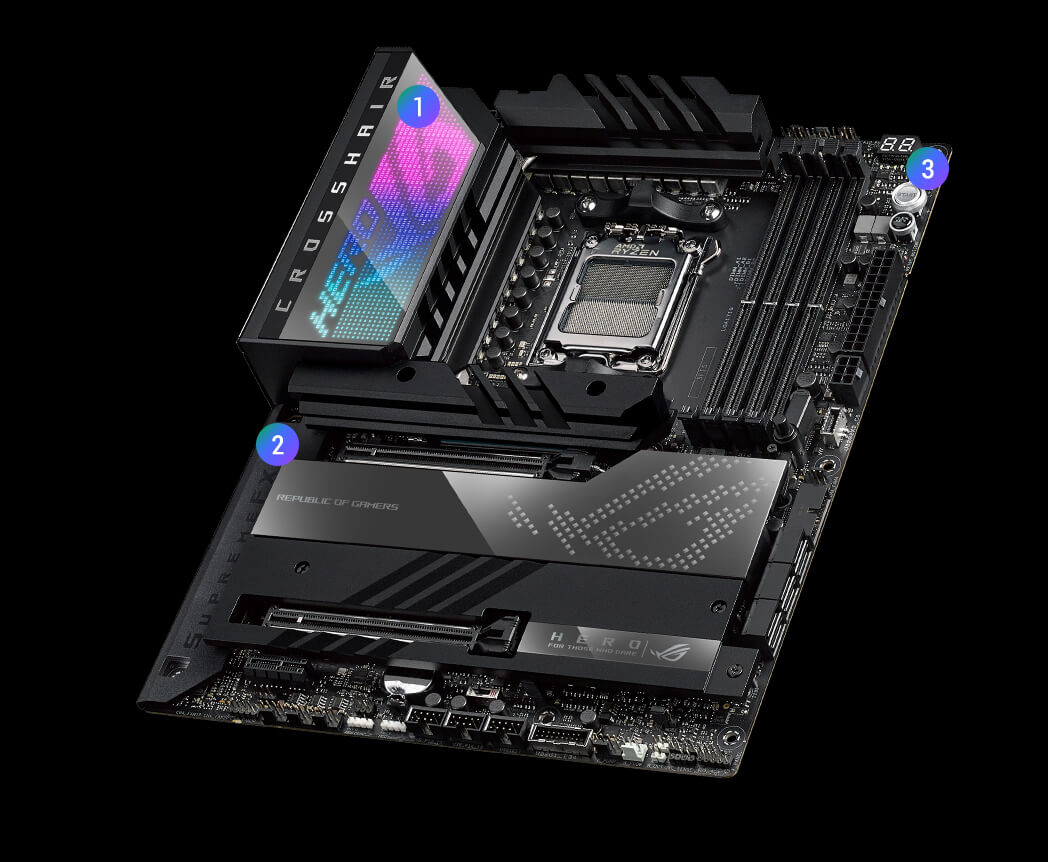

Republic of Gamers (ROG), part of the ASUS family, is dedicated to creating innovative hardcore gaming hardware for gamers. ROG is committed to providing the absolute best performance and quality from its complete line of products. ROG is for those keen on the finest gaming hardware and software as it enables the ultimate computing experience for gamers and enthusiasts worldwide. It incorporates a stylish gamer-focused design, merging the excitement of gaming with a unique premium style.
Unyielding power delivery and robust thermal management form the indelible tenets of its creed. Hyperspeed connectivity, comprehensive PCIE 5.0 and DDR5 support, and Polymo lighting add potent layers of build personalization on top. And the finishing touches are added by exclusive utilities and overclocking controls that allow you to uniquely flex the performance of Ryzen 7000 Series processors. Define your AM5 build with the ROG Crosshair X670E Hero.
|
|
|
|
|---|---|---|
DYNAMIC OC SWITCHERLightly-threaded tasks get fantastic uplift using AMD Precision Boost Overdrive (PBO), but all-core frequencies can be pushed higher via traditional overclocking. The Dynamic OC Switcher lets you use them both, dynamically engaging PBO or your preferred settings based on the CPU current or temperature. |
CORE FLEXCore Flex empowers you to smash limits farther than ever before by letting you control clock, power, and thermals in creative new ways. In its simplest form, you can maximize the base clock during lighter loads and set breakpoints to gradually reduce CPU core frequency as temperature or current increases. But the system is extremely adaptable, supporting multiple user-controlled functions that can manipulate power, current, and temperature limits independently so that you can bend CPU performance to your will. |
TEAMED POWER ARCHITECTUREToday's CPU architectures place incredible demands on the motherboard power design by transitioning from deep powersaving modes, going from lower power mode to full load in an instant. The latest ROG VRM architecture rises to the challenge by utilizing teamed power stages to rapidly swing current, while maintaining exemplary thermal performance. |
|
|
|
|
|---|---|---|
MEMORYComprehensive memory tuning options are the cornerstone of ROG motherboards. With the ROG Crosshair X670E Hero, you can extract all of the potential out of your DDR5 modules, regardless of if they're from an extreme-speed kit or an entry level set that would otherwise be locked. |
PCIE 5.0Fully embracing the new standard, the ROG Crosshair X670E Hero offers abundant Gen 5 support to give unfettered bandwidth to the fastest SSDs and graphics cards available. |
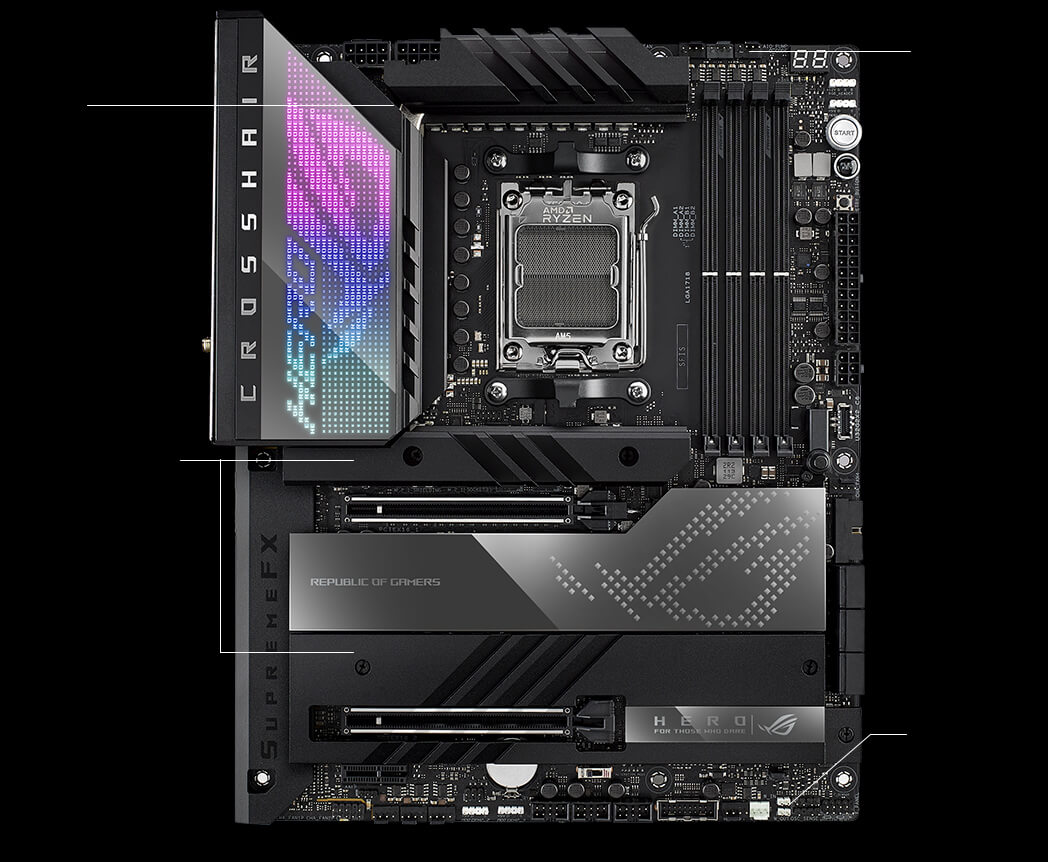
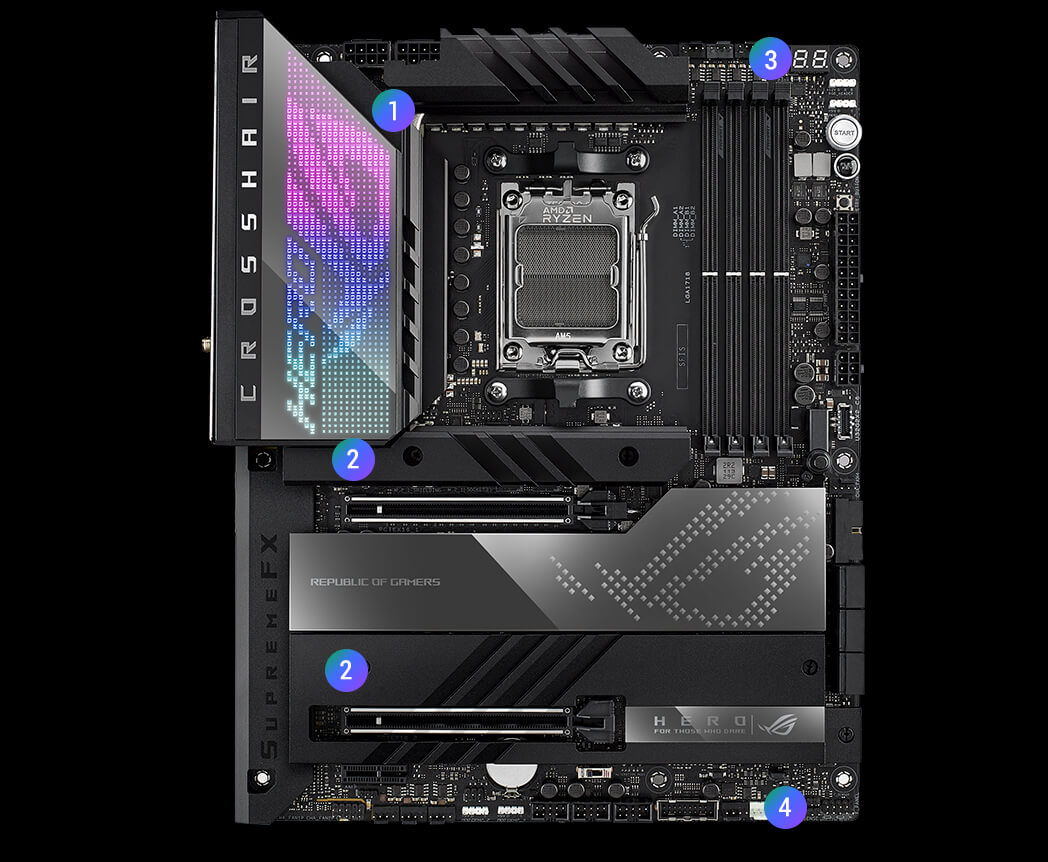
COOLER BY DESIGN1. VRM heatsinks and heatpipe 2. M.2 heatsinks 3. High-conductivity thermal pads 4. M.2 backplate 5. Chipset heatsink |
|
|
|
|
|---|---|---|
TWO USB4 TYPE-C PORTSEach USB4 port delivers up to 40 Gbps of bidirectional bandwidth for the latest super-speed devices and drives. External display support reaches up to 8K output if one of the ports is in use, or both can be employed for dual 4K displays. |
SUPREMEFXROG SupremeFX audio technology delivers an exceptional 113 dB signal-to-noise ratio on the line-in connection to provide exceptional recording quality. There’s also a low-dropout regulator for cleaner power delivery to the SupremeFX ALC4082 codec, and an integrated ESS ES9218 quad DAC capable of reaching -115dB THD+N for superior front-panel output. The combined solution allows for end-to-end 32-bit 384 kHz resolution playback that conveys all the subtlety and nuances of each audio track. |
GROW YOUR GAMING WORLD WITH AURA SYNCUp your game with complementary Aura Sync enhanced aesthetics, featuring preset lighting effects that can be easily synchronized across compatible ROG graphics cards, monitors, keyboards, and mice to give your setup a unified look. |
استناداً إلى سجلات الأسعار المتاحة، وليس ضماناً لأعلى أو أدنى سعر على الإطلاق.
لم يتغيّر سعر هذا المتجر منذ تسجيله أول مرة في 2026-10-25، وهو حالياً 499 د.أ.
| التاريخ | السعر | التغيير |
|---|---|---|
| 2026-10-25 | 499 د.أ | أول تسجيل |
ROG Crosshair X870E Hero
مقارنة عبر 5 متاجر
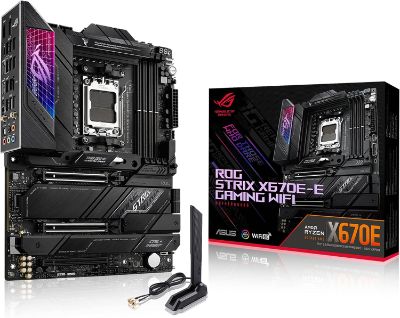
X670E-E Gaming WiFi
مقارنة عبر متجرين
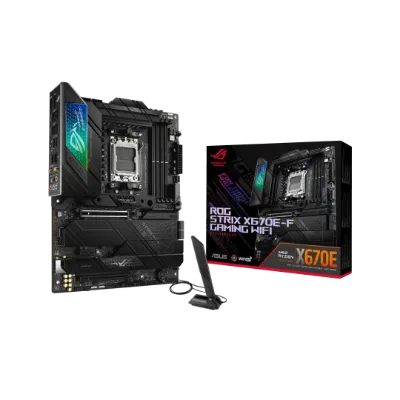
ROG Strix X670E-F Gaming WiFi · ATX
مقارنة عبر 3 متاجر
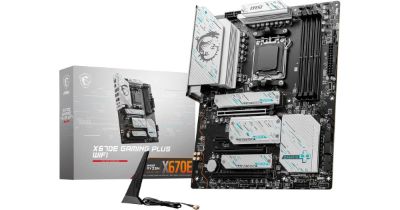
X670E GAMING PLUS WIFI
مقارنة عبر 4 متاجر